Would you like to explore how the concept of Satan evolved across different world religions?
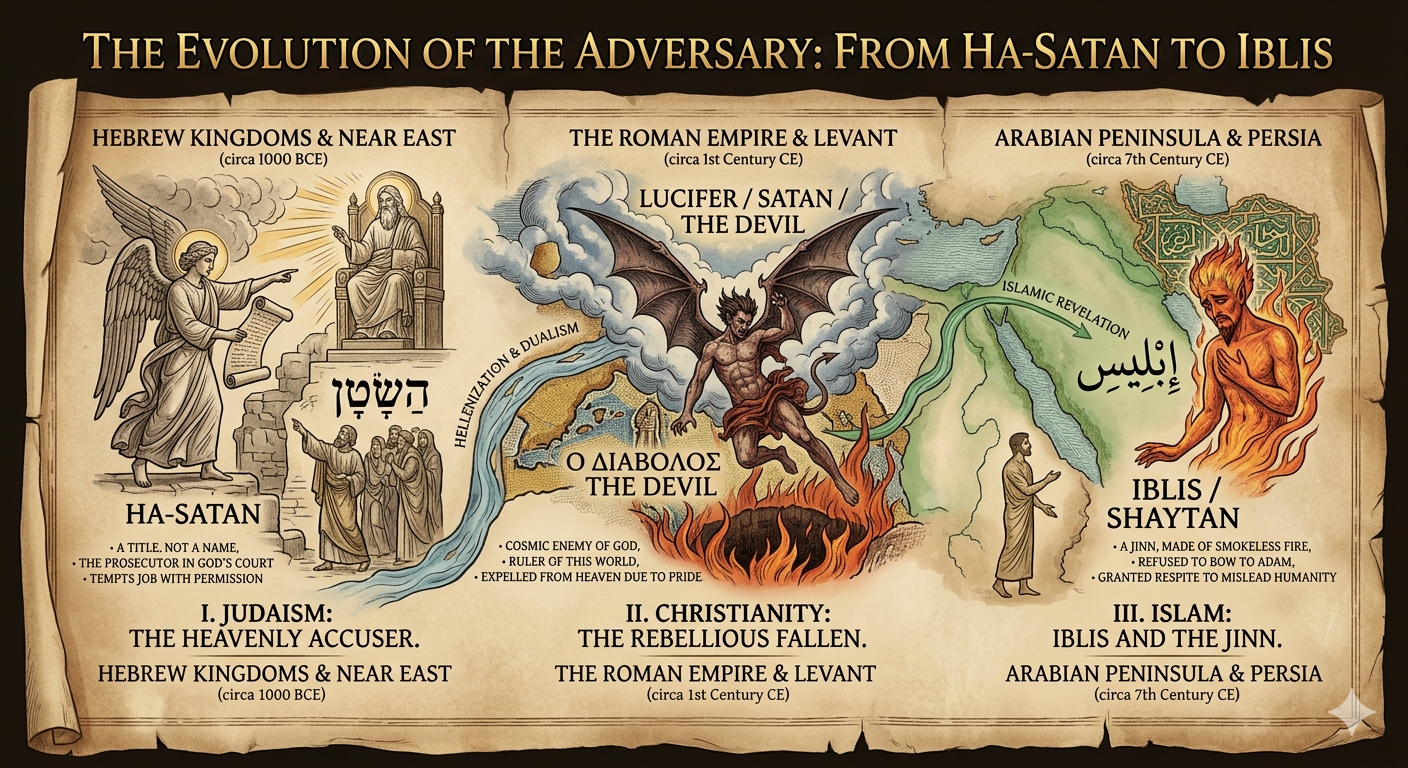
Yes, let’s explore that evolution. The concept of a central figure of evil or an adversary didn’t appear overnight; it evolved over thousands of years, shifting dramatically as it moved through different world religions.
Here is how the figure of Satan transformed from a heavenly civil servant into the cosmic enemy of God:
1. Judaism: The Heavenly Prosecutor
In the Hebrew Bible (Old Testament), the concept of Satan is very different from modern popular imagination.
- A Title, Not a Name: The word satan originates as a title or a verb, meaning “adversary,” “obstacle,” or “accuser.”
- The Heavenly Court: In the Book of Job, Ha-Satan (literally “The Accuser”) is not an enemy of God or a fallen angel ruling Hell. Instead, he functions like a prosecuting attorney in God’s heavenly court.
- Under God’s Control: He cannot act without God’s explicit permission. His role is to test human loyalty and righteousness, acting as a loyal servant of God rather than a cosmic rebel.
2. Intertestamental Period: The Shift to Cosmic Evil
Between the completion of the Hebrew Bible and the writing of the New Testament (roughly 300 BCE to 100 CE), Jewish thought was heavily influenced by historical crises (like the Babylonian exile and Greek occupation) and exposure to Zoroastrianism—an ancient Persian religion.
- Dualism: Zoroastrianism introduced a strict dualistic worldview: a cosmic war between a god of total light/good (Ahura Mazda) and a spirit of total darkness/evil (Angra Mainyu).
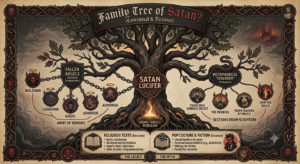
- Apocryphal Texts: During this time, Jewish apocryphal literature (like the Book of Enoch) began to merge the concept of the Biblical “accuser” with stories of rebellious, fallen angels (the Watchers) led by figures named Semjaza or Azazel. This is where the idea of a cosmic rebellion against God took root.
3. Christianity: The Fallen Rebel & Cosmic Enemy
By the time the New Testament was written, the transformation was complete. The early Christian Church fully embraced the idea of a personalized, cosmic enemy.
- The Ultimate Adversary: Satan became a specific individual, also identified as the Devil (Diabolos in Greek, meaning “slanderer”). He was cast as the “ruler of this world” who stands in direct opposition to the Kingdom of God.
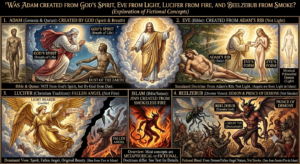
- The Fall of Lucifer: Later Christian theologians connected passages from Isaiah and Ezekiel (originally written as taunts against earthly kings of Babylon and Tyre) to describe the origin story of Satan: a beautiful high angel named Lucifer who fell from heaven due to the sin of pride.
- The Final Defeat: Christianity added an apocalyptic timeline, concluding with the Book of Revelation, where Satan is destined to be permanently defeated and cast into the Lake of Fire.
4. Islam: Iblis and the Sin of Pride
In the Quran and Islamic tradition, the figure of the devil is known as Iblis or Shaytan. While his role as a tempter is similar to Christianity, his origin story and nature differ in key ways.
- A Jinn, Not an Angel: In Islamic theology, angels are made of light and lack free will—they cannot disobey God. Therefore, Iblis is classified as a Jinn (a being made of smokeless fire) who possessed free will. Because of his immense piety, he had been elevated to live among the angels.
- The Refusal to Bow: The critical moment of Iblis’s fall occurs when Allah creates Adam and commands all creation to bow before him. Driven by arrogance, Iblis refuses, arguing: “I am better than he. You created me from fire and created him from clay.”
- The Respite: Banished for his arrogance, Iblis begs Allah for a respite until the Day of Judgment. Allah grants it, and Iblis vows to spend that time misguiding and whispering temptation (waswas) into the hearts of humanity to prove they are unworthy.


Post Comment
You must be logged in to post a comment.