How does satan die?
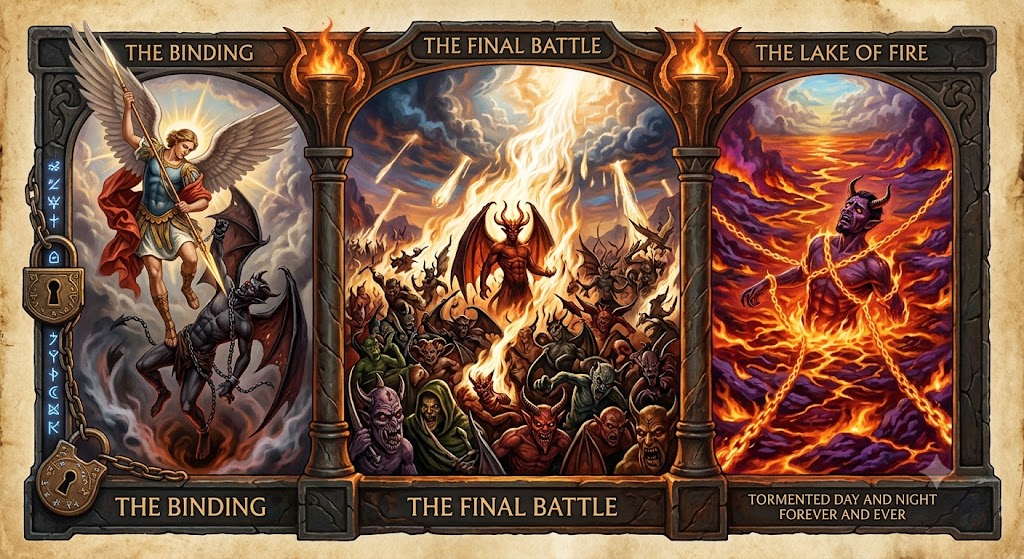
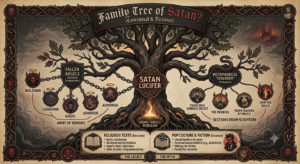
How Satan dies depends entirely on the religious or literary tradition you look at, though in the most prominent texts, it’s less about a physical “death” and more about eternal, inescapable destruction.
Here is how his end is described across different perspectives:
1. The Christian Biblical Account
In mainstream Christian theology, angels (including fallen ones) are immortal spiritual beings, so Satan doesn’t “die” in the biological sense. Instead, his ultimate fate is described as permanent, agonizing defeat.
According to the Book of Revelation (Chapter 20), his end comes in stages:
- The Bound Period: He is first cast into a bottomless pit and sealed there for 1,000 years.
- The Final Defeat: After being released briefly, he gathers an army for one last rebellion but is instantly defeated by divine fire from heaven.
- The Lake of Fire: He is finally thrown into the “Lake of Fire and Brimstone,” where he is explicitly stated to be “tormented day and night forever and ever.”
Key Takeaway: In Christianity, Satan never rules Hell. He is its ultimate prisoner, experiencing an eternal “spiritual death” (complete and permanent separation from God).
2. The Islamic Account (Iblis)
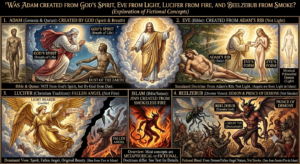
In Islam, the devil figure is known as Iblis (a Jinn, rather than a fallen angel).
- According to the Quran, when Iblis refused to bow to Adam, he was banished. However, he requested a reprieve from Allah to delay his punishment until the Day of Judgment so he could try to mislead humanity.
- Allah granted this reprieve. On the Day of Resurrection, Iblis’s time runs out. He, along with his followers and the wicked, will be cast into Jahannam (Hell) to face eternal punishment. Like the Christian view, it is an eternity of torment rather than cessation of existence.
3. Milton’s Paradise Lost (Literary)
In John Milton’s epic 17th-century poem, Satan doesn’t die at the end. Instead, he suffers a psychological and physical degradation. Upon returning to Hell to brag about successfully corrupting Adam and Eve, he and all his fallen angels are suddenly and involuntarily transformed into hissing serpents, forced to chew on beautiful fruit that turns to bitter, dusty ash in their mouths. It symbolizes a perpetual, frustrating living death.
4. Pop Culture and Mythology
In various modern fantasy genres, video games, and TV shows (like Supernatural or Lucifer), writers often give Satan a tangible form that can be killed using specific divine weapons (like the Colt, an archangel blade, or celestial steel). However, these are modern creative inventions rather than traditional theological beliefs.


Post Comment
You must be logged in to post a comment.