What does God look like?
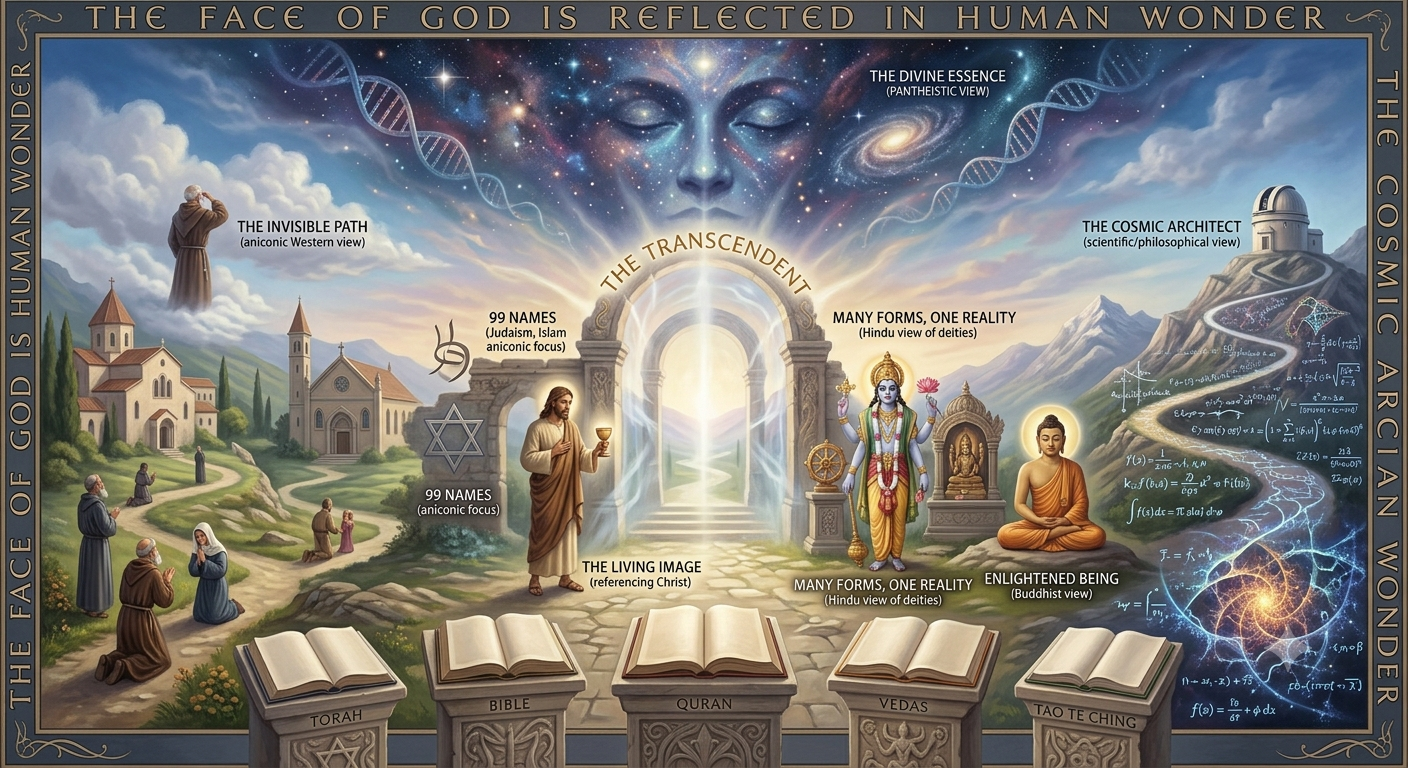
That is one of the oldest, deepest, and most beautifully complicated questions humanity has ever asked. Because “God” means different things to different people, the answer depends entirely on the lens you are looking through.
Here is how different cultures, religions, and philosophies have pictured the divine throughout history:
1. The Western Monotheistic View (Abrahamic)
In Judaism, Christianity, and Islam, God is historically understood as a spiritual, transcendent being without a physical body. However, how this is approached varies:
- Islam & Judaism: Both traditions strictly forbid physical depictions of God. God is considered entirely beyond human comprehension and physical form. In Islam, God (Allah) is described through 99 names/attributes (like The Merciful, The All-Knowing), focusing on character rather than appearance.
- Christianity: While God the Father is traditionally viewed as spirit, Christianity believes God took on a physical, human form in Jesus Christ.
- Artistic Interpretations: Despite theological rules, Western art has heavily shaped our imagination. Think of Michelangelo’s Sistine Chapel: a powerful, white-bearded man reaching out from the heavens. This “cosmic grandfather” image has dominated Western pop culture for centuries.
2. Eastern Traditions and Polytheism
Eastern religions offer a rich tapestry of both highly physical and entirely formless concepts of the divine.
- Hinduism: The divine (Brahman) is an ultimate, formless reality, but it manifests in countless physical forms (Deities) to help humans connect with it. These forms are incredibly varied and symbolic—like Ganesha (depicted with an elephant head, symbolizing wisdom and removing obstacles) or Kali (representing destruction and transformation).
- Buddhism: While not focused on a creator God, enlightened beings (Buddhas and Bodhisattvas) are depicted with serene expressions, elongated ears (signifying spiritual hearing), and specific hand gestures (mudras) to represent peace and teaching.
- Taoism: The Tao (the Way) is not a person or a deity, but the invisible flow of the universe. It has no face; it is simply the natural order.
3. Philosophical and Scientific Views
For those who look at the universe through a philosophical or pantheistic lens, “God” isn’t a person at all.
- Pantheism (Spinoza’s God): Popularized by philosophers like Baruch Spinoza and admired by Albert Einstein, this view suggests that God is the universe itself. In this sense, God looks like a nebula, a forest, a DNA strand, or the person looking in the mirror.
- The Mathematical Universe: Some physicists and philosophers suggest that if there is a divine architect, its “face” is written in the elegant, immutable laws of mathematics and physics that govern reality.
The Takeaway: Perhaps the most universal answer is that God looks like whatever helps a person connect with the infinite. Whether that is a majestic king in the clouds, a multi-armed deity, the laws of physics, or the quiet space in your own heart, the “look” is ultimately a mirror of human wonder.
What led you to think about this today—are you looking at this from a philosophical, artistic, or personal perspective?




Post Comment
You must be logged in to post a comment.