

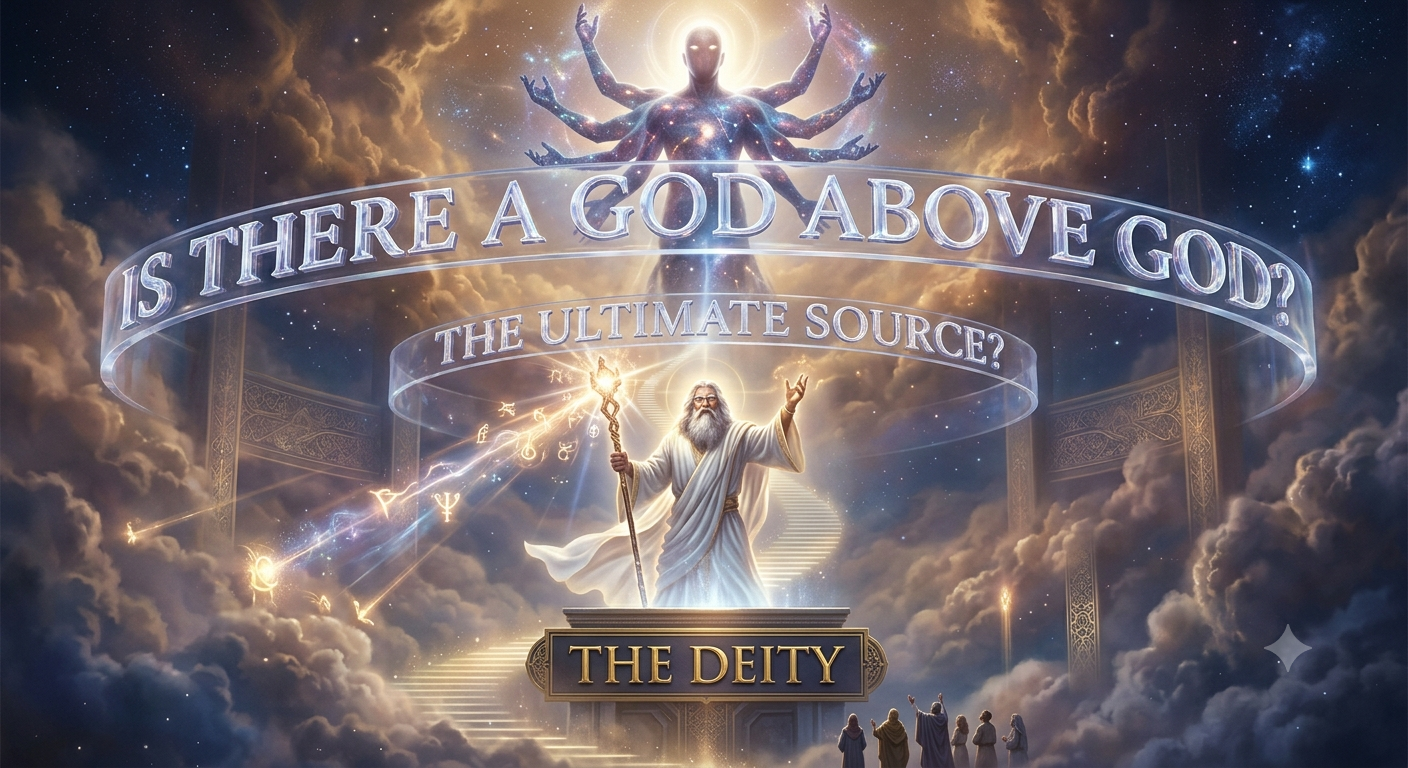
When we switch from asking if there is a god above God to whether there is another god besides God, we move from the structure of reality into a question of numbers and definitions.
The answer changes dramatically depending on whether you are looking through the lens of history, anthropology, or specific religious doctrines.
1. The Monotheistic View: “No, by Definition”
In Judaism, Christianity, and Islam, the answer is an absolute no.
These religions practice monotheism (the belief in only one God). However, it goes deeper than just a headcount. In classical theology, God is not seen as “one specimen of a species called gods.” Instead, God is defined as the unique source of all existence.
The Logic: If two all-powerful, infinite beings existed, they would limit each other. If Being A can prevent Being B from doing something, Being B isn’t all-powerful. If Being A cannot stop Being B, then Being A isn’t all-powerful. Therefore, logically, there can only be one supreme ultimate reality.
2. The Polytheistic View: “Yes, Many”
In polytheistic traditions—such as ancient Greek, Norse, or Egyptian mythologies, as well as Shinto and many Indigenous religions—the universe is populated by a multitude of gods.
- These gods are typically not “all-powerful” or infinite.
- Instead, they are powerful, immortal beings who rule over specific domains (like the sea, war, wisdom, or the sun).
- In this view, asking if there is another god is like asking if there is another king or another country—the cosmos is a vast ecosystem with room for many distinct powers.
3. Henotheism: “Other Gods Exist, But We Only Worship One”
Before strict monotheism became the norm in the ancient Near East, many cultures practiced henotheism—the belief in and worship of a single god while accepting that other gods exist for other people.
- Ancient Israel: Many historians and biblical scholars point out that early Israelites may have practiced henotheism or monolatry. Ancient texts often frame the debate not as “do other gods exist?” but rather “our God is stronger than the gods of Egypt or Babylon.” Commandments like “You shall have no other gods before me” historically implied that those other gods were perceived as real rivals to be avoided.
4. Hinduism: “Many Names for One Reality”
Hinduism offers a unique bridge between these ideas. To an outside observer, it looks polytheistic because of the thousands of distinct deities (like Ganesha, Lakshmi, or Hanuman). However, beneath the surface, it is profoundly monistic or pantheistic.
- Most Hindus view these distinct gods not as separate, competing entities, but as different faces, personalities, or manifestations of the one ultimate, divine reality (Brahman).
- So, are there other gods? Yes, in form and name. No, in ultimate substance.
Ultimately, the answer hinges entirely on what you mean by “god.” If a god is a powerful spirit or force, history says yes, humans have found many. If God is the ultimate, infinite source of all that is, then by definition, there cannot be a second.
Leave a Reply
You must be logged in to post a comment.