Who was Albert Einstein?
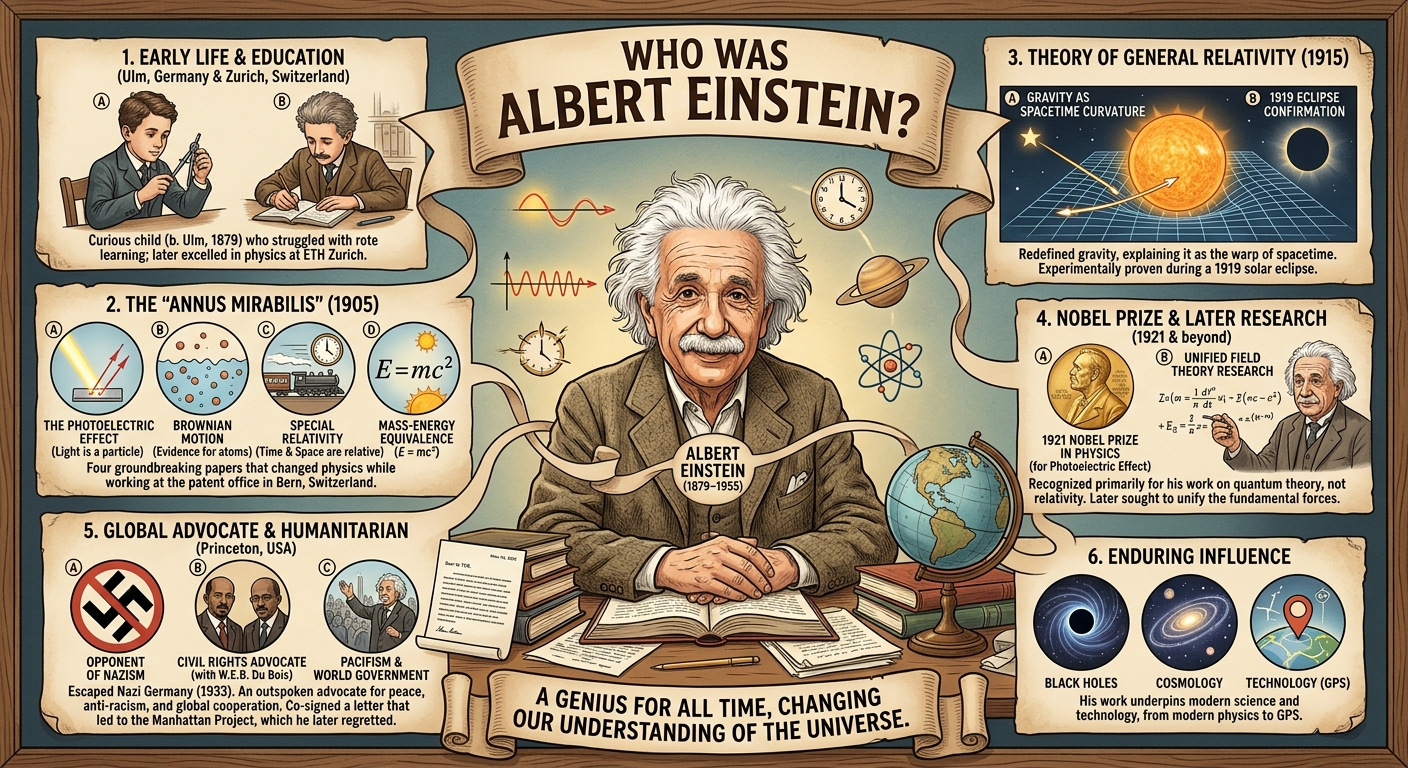
Albert Einstein was a visionary German-born theoretical physicist who is widely considered one of the most influential scientists of all time.
His work fundamentally altered our understanding of the universe, and he remains an iconic figure whose name is synonymous with genius.
Here is an overview of why he is so famous.
Major Scientific Breakthroughs
Einstein’s primary legacy rests on two major pillars of modern physics:
- Theory of Relativity:
- Special Relativity (1905): He revolutionized the concept of time and space, showing that they are relative to the observer’s motion.
- General Relativity (1915): He expanded on this to include gravity, describing it not as a force, but as the curvature of spacetime caused by mass. This theory predicted black holes, gravitational waves, and the expansion of the universe.
- The Photoelectric Effect: In 1905, he proposed that light can act not only as a wave but also as discrete packets of energy (now called photons). This work was crucial in the development of quantum mechanics.
Most Famous Contribution to Popular Culture
Perhaps his most enduring legacy in the public eye is the formula for mass-energy equivalence:
E=mc2
This seemingly simple equation shows that mass and energy are interchangeable. It paved the way for the development of nuclear energy and, eventually, atomic weapons.
The Nobel Prize and Humanitarian Legacy
While relativity is his most famous theory, Einstein was actually awarded the 1921 Nobel Prize in Physics specifically for his explanation of the photoelectric effect.
Beyond his scientific work, Einstein was also known for:
- A Pacifist Advocate: He was a vocal advocate for peace, although he famously signed a letter to President Franklin D. Roosevelt warning him of the potential for German nuclear weapons, which indirectly led to the creation of the Manhattan Project.
- Civil Rights: He spoke out frequently against racism and antisemitism.
Ultimately, Albert Einstein is remembered not just for the complexity of his theories, but for the profound curiosity and humanity that drove him to question everything we thought we knew about the fabric of reality.