Who is the inventor? – + x ÷
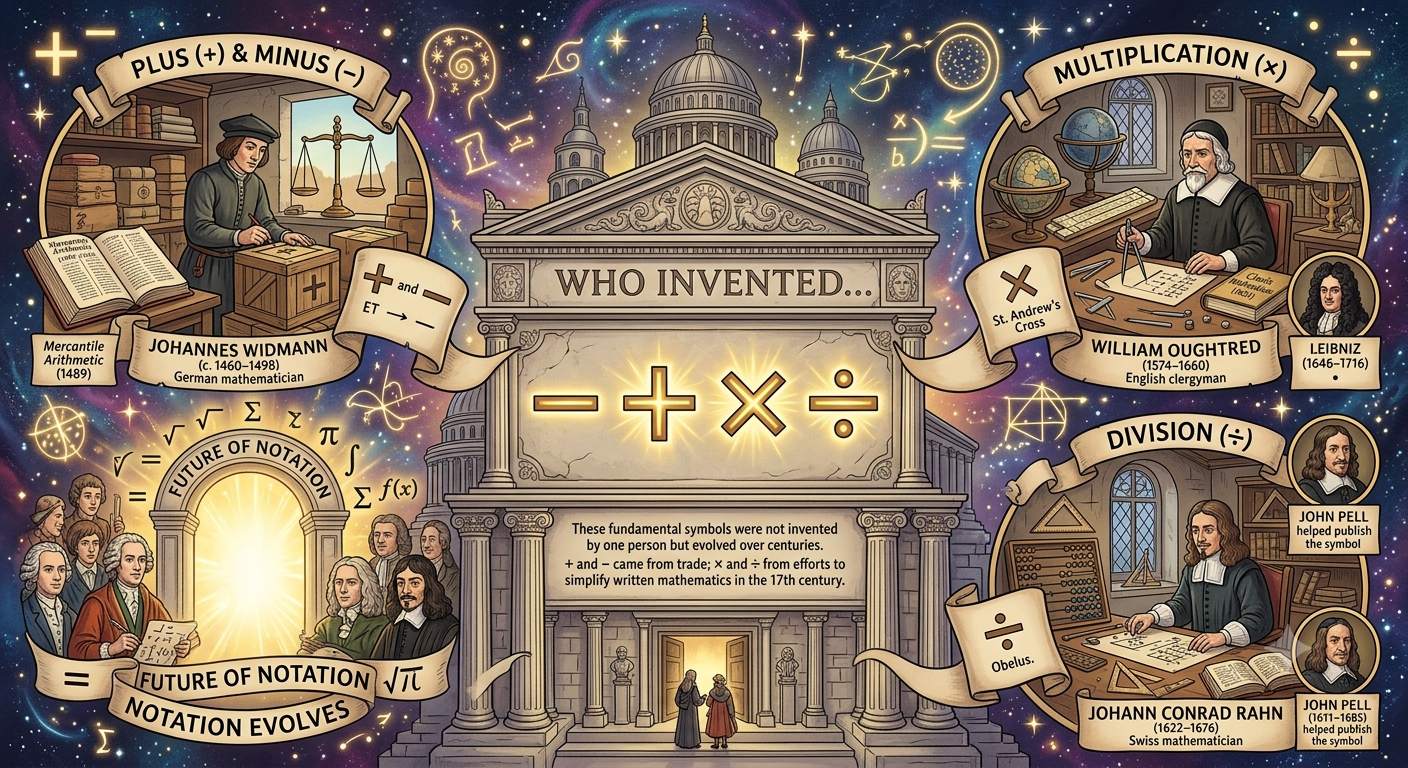
The mathematical symbols for addition, subtraction, multiplication, and division were not all invented by a single person at the same time. They were introduced by various scholars over the course of a few centuries.
Here is an overview of who created what:
+ (Plus) and – (Minus)
- Who: Johannes Widmann (a German mathematician)
- When: 1489
- Details: They first appeared in print in his book Mercantile Arithmetic. Originally, they were used in trade to indicate a surplus (
+) or a deficit (-) of goods. Only later did they become official mathematical symbols.
× (Multiplication)
- Who: William Oughtred (an English mathematician and clergyman)
- When: 1631
- Details: He introduced the St. Andrew’s cross (
×) in his work Clavis Mathematicae. - Fun fact: The famous scholar Gottfried Wilhelm Leibniz disliked this symbol because it looked too much like the letter x. Therefore, in 1698, he proposed using a dot (
·) for multiplication, which is still the standard in higher mathematics today.
÷ (Division)
- Who: Johann Rahn (a Swiss mathematician)
- When: 1659
- Details: Rahn used this symbol (known as the obelus) for the first time in his book Teutsche Algebra.
- Note: In modern mathematics and computer science, the division sign is often replaced by a forward slash (
/), which was popularized as early as 1718 by John Rowe.
In summary:
| Symbol | Operation | Inventor | Year |
| + and – | Plus & Minus | Johannes Widmann | 1489 |
| × | Multiplication | William Oughtred | 1631 |
| ÷ | Division | Johann Rahn | 1659 |