Can humans live in space?
Yes, humans can live in space — but for now, only with a lot of technological support.
Humans have been living in space continuously aboard the International Space Station (ISS) since November 2000. But living there permanently and independently of Earth? That is a whole different story.
The Biggest Challenges in Space
Our bodies have evolved perfectly for life on Earth. As soon as we leave the protective bubble of our planet, we run into a few major obstacles:
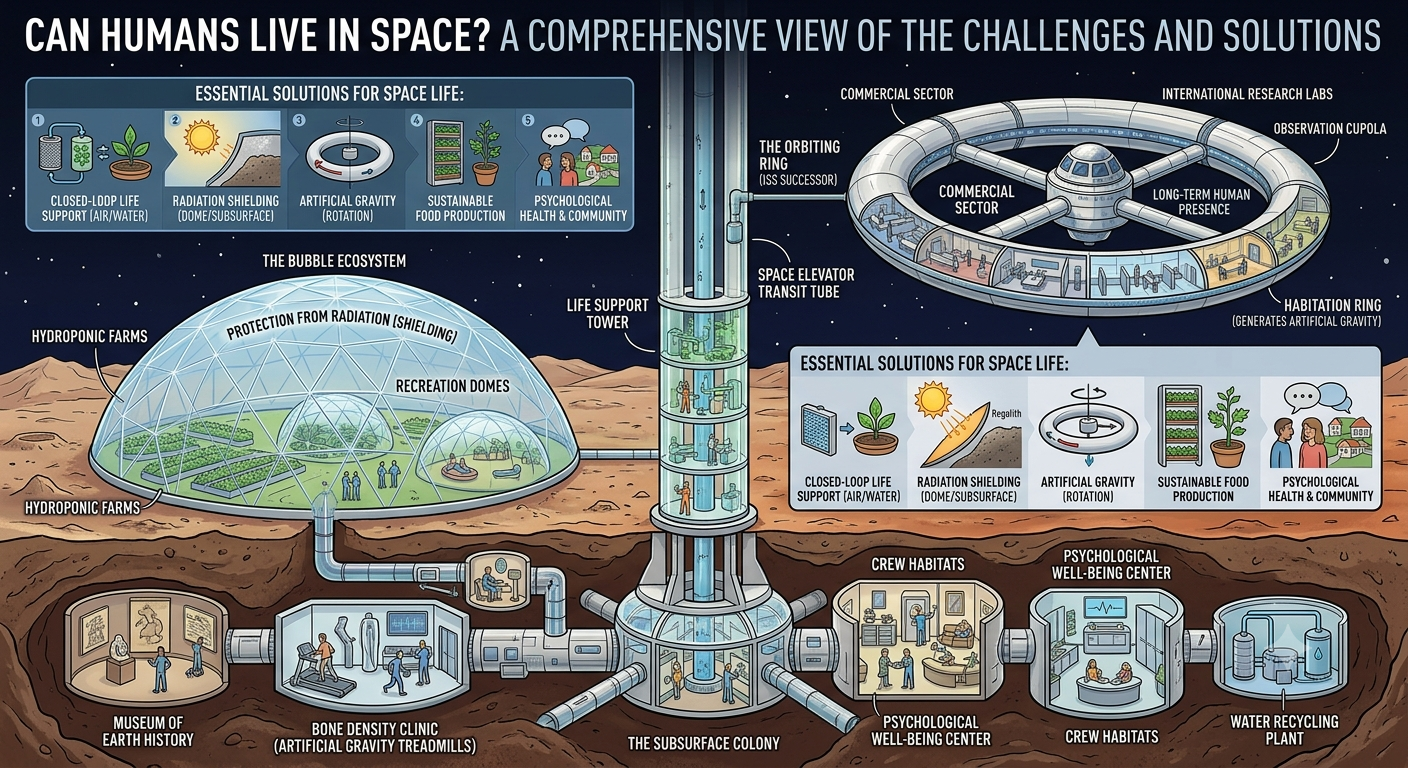
- Weightlessness (Microgravity): Without gravity, your muscles and bones don’t have to work. Astronauts quickly lose bone density and muscle mass. To combat this, they must exercise intensely for at least two hours a day on the ISS.
- Dangerous Radiation: On Earth, our magnetic field protects us from harmful cosmic and solar radiation. In space (and on the Moon or Mars), this radiation significantly increases the risk of cancer and other health issues.
- Life Support (Air, water, food): There is no oxygen or drinking water in space. Everything must be brought along or recycled. On the ISS, for example, around 90% to 98% of all liquids (including sweat and urine) are filtered into pure drinking water.
- Psychological Pressure: Being confined to a small space with the same few people for long periods, far away from family and nature, places an extreme mental demand on a person.
What Does the Future Look Like?
To truly live sustainably somewhere else (such as on the Moon or Mars), scientists are working on:
- Self-sustaining ecosystems: Growing plants in closed environments for both food and oxygen.
- Radiation protection: Building habitats underground or covering them with a thick layer of lunar or Martian dust (regolith).
- Artificial gravity: Rotating spaceships or stations to generate fake gravity using centrifugal force.