Who goes to heaven or hell?
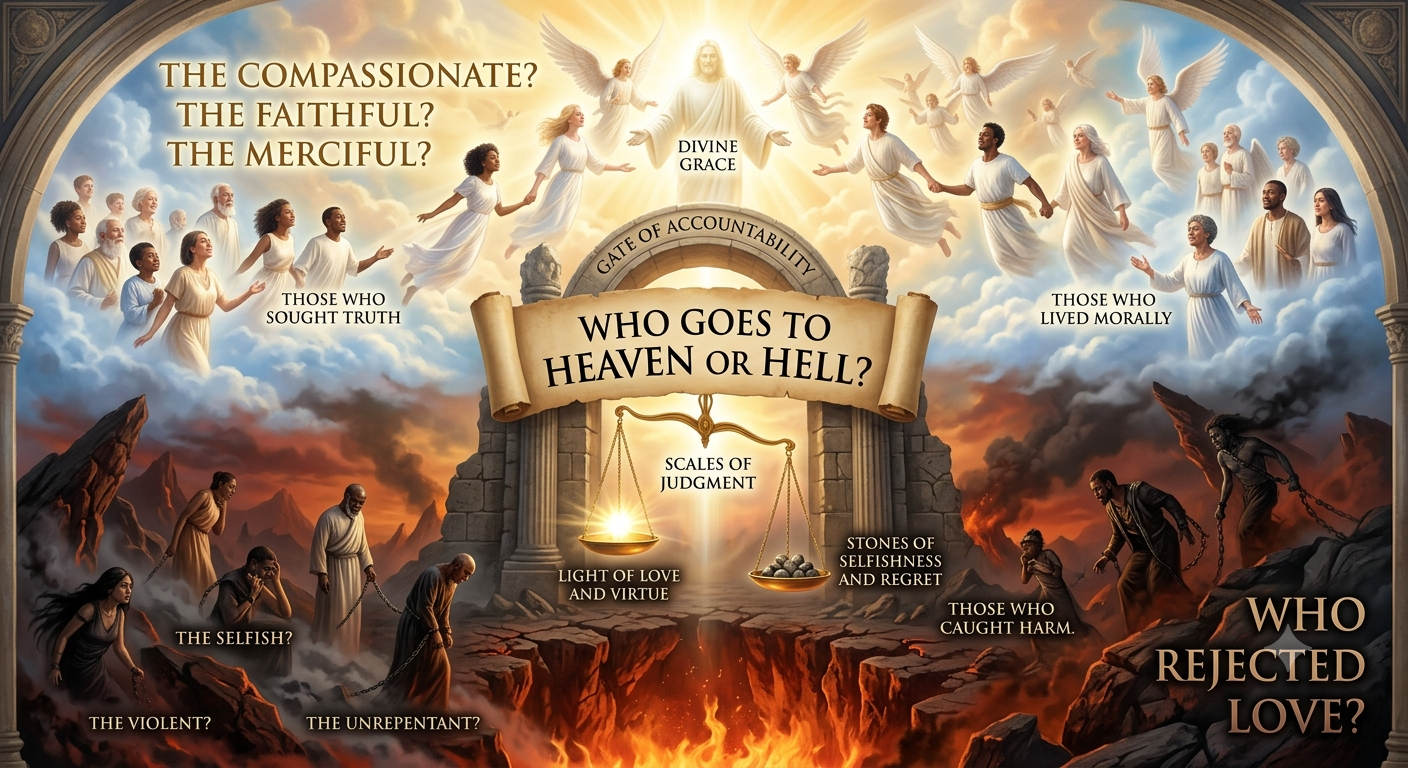
The question of who goes to heaven or hell is one of the most fundamental concerns of religion, philosophy, and mythology. The answer varies drastically depending on the belief system being consulted.
There is no single, globally accepted answer, but rather a spectrum of cultural, theological, and philosophical perspectives. Here is a breakdown of who goes to heaven or hell according to different traditions.
Abrahamic Religions
These faiths generally share a linear view of history, where life on Earth is followed by a final judgment leading to an eternal afterlife.
| Tradition | General View of Salvation | Who Goes to Heaven (Paradise/Jannah)? | Who Goes to Hell (Gehenna/Jahannam)? |
| Christianity | The core requirement is typically faith in Jesus Christ, often accompanied by repentance from sin and good works. | The Righteous and the Saved: Those who believe in the sacrifice of Jesus for their sins. Their belief is manifested in love and obedience to God. | The Unbelievers and Unrepentant: Historically, those who reject God’s grace through Christ. Modern views may emphasize hell as the result of a definitive choice to separate oneself eternally from God. |
| Islam | Salvation is achieved through strict belief in the One God (Allah) and submission to His will, as revealed through the Quran. | The Believers (Mu’minun) and the Pious (Muttaqun): Those who worship Allah alone, believe in his Prophets, and perform righteous deeds (prayer, charity, fasting, pilgrimage). | The Non-Believers (Kafirun): Those who reject the oneness of God (Shirk) or the message of Islam, and those who commit major sins without repentance, particularly after knowing the truth. |
| Judaism | The focus is primarily on life here and now, following the Torah’s commandments (mitzvot). The afterlife is less defined than in Christianity or Islam. | The Righteous (Tzadikim) of all nations: Those who live a moral life and follow the fundamental ethical laws (like the Noahide Laws), not just Jews. | Judaism generally does not emphasize an eternal hell of physical torment. There is Gehinnom, but it is often viewed as a temporary place of purification or spiritual rehabilitation lasting up to twelve months. Only the extremely wicked might face annihilation rather than eternal suffering. |
Eastern Traditions
Hinduism and Buddhism view time as cyclical. Heaven and hell are not permanent, eternal destinations, but temporary states within the cycle of reincarnation.
| Tradition | General View of the Afterlife | Who Goes to a Heavenly Realm? | Who Goes to a Hellish Realm? |
| Hinduism | One’s karma (the results of good and bad actions) determines the next life, which could be on Earth, in a temporary heavenly realm, or in a temporary hellish realm. The ultimate goal is Moksha (liberation from the cycle). | The Virtuous: Those with a preponderance of positive karma, accrued through good deeds, charity, devotion to God, and following one’s dharma (duty). They enjoy refined, joyous existences. | The Sinful: Those with major negative karma, incurred through wicked deeds, violence, deceit, and selfishness. They experience suffering appropriate to their sins before being reborn. |
| Buddhism | Similar to Hinduism, karma dictates rebirth within the six realms of existence, including heavens and hells. The final goal is Nirvana (extinction of suffering and rebirth). | Those with Good Karma: Beings who practiced generosity, morality, patience, and compassion. They are reborn as gods (devas) in pleasant realms, though still subject to eventual death and rebirth. | Those with Bad Karma: Beings who committed grievous negative actions (killing, stealing, harming others) or held strong negative mental states (greed, anger, ignorance). They are reborn in various hell realms (Naraka) to exhaust that karma. |
Philosophical and Secular Perspectives
Secular and non-religious views offer a dramatic contrast to theological ones, focusing on the metaphorical or purely worldly aspects of the concept.
- Agnosticism and Atheism: From these perspectives, there is usually no belief in a supernatural afterlife. “Going” anywhere after death is considered impossible. The focus shifts to making this life meaningful, ethical, and peaceful, rather than working toward a reward or avoiding punishment after death.
- Psychological/Existential Views: Some philosophies interpret heaven and hell not as literal places, but as states of mind or human conditions experienced during life:
- “Heaven” represents inner peace, harmony, contentment, and a sense of belonging or purpose.
- “Hell” represents remorse, severe isolation, despair, chronic anxiety, and self-inflicted suffering. As the philosopher Jean-Paul Sartre famously stated, “Hell is other people,” illustrating how human conflict can create hellish existences on Earth.