What can you do about stress?
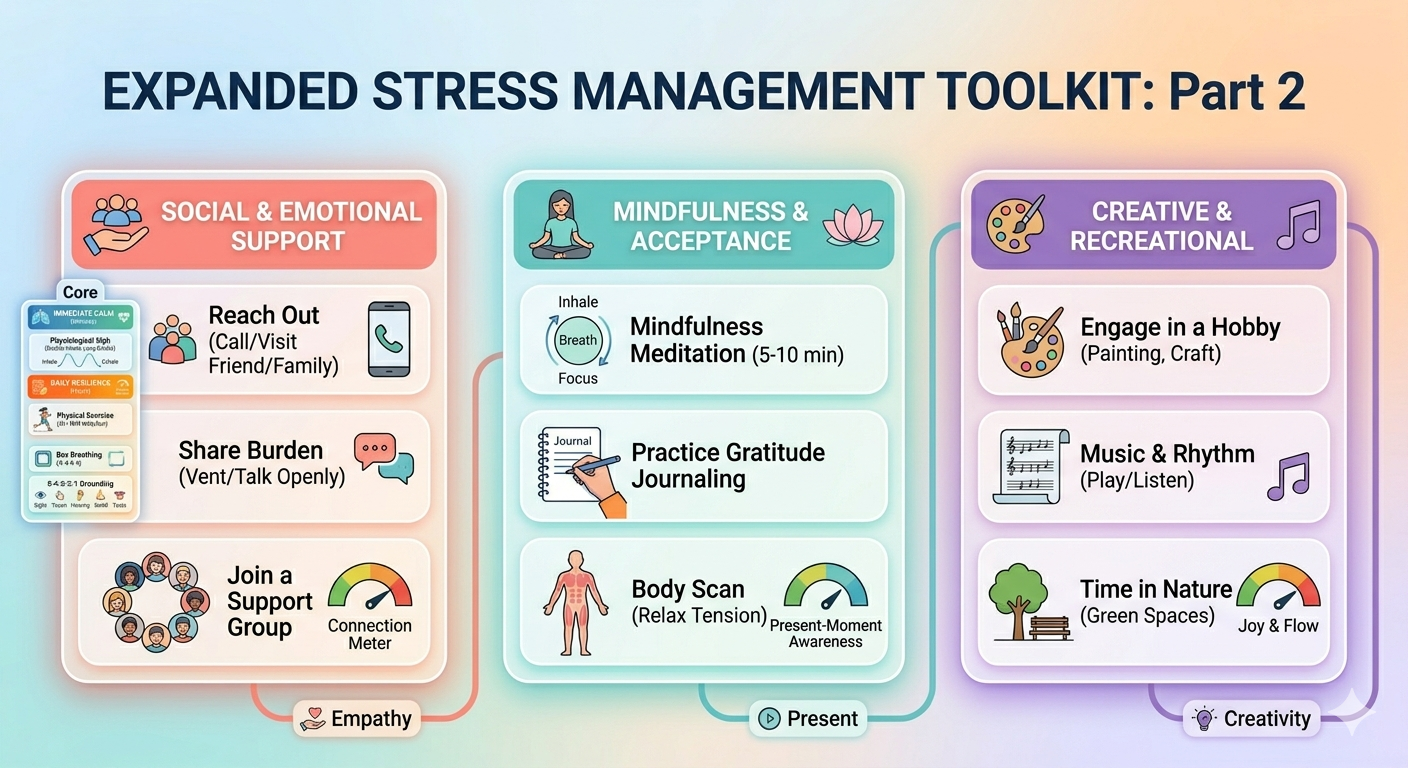
Dealing with stress can feel overwhelming, but managing it effectively usually comes down to a mix of immediate “circuit breakers” and long-term habits. Because stress triggers a physical “fight or flight” response, the goal is to send a signal back to your brain that you are safe.
Here is a toolkit of evidence-based strategies you can use to manage stress, broken down by how quickly they work.
1. Immediate “Circuit Breakers” (Works in Minutes)
When stress hits hard and your heart starts racing, use these to calm your nervous system right away:
- The Physiological Sigh: Take two quick breaths in through your nose (one deep breath, followed immediately by a sharp “top-off” inhale), then a long, slow exhale through your mouth. Doing this just 2 or 3 times rapidly lowers your heart rate.
- Box Breathing: Inhale for 4 seconds, hold for 4 seconds, exhale for 4 seconds, and hold empty for 4 seconds. Repeat for a few rounds. This is a technique used by Navy SEALs to stay calm under intense pressure.
- The 5-4-3-2-1 Grounding Method: Look around your room and name:
- 5 things you can see.
- 4 things you can physically feel (e.g., your feet on the floor).
- 3 things you can hear.
- 2 things you can smell.
- 1 thing you can taste.
- Why it works: It forces your brain to shift out of the “worry loop” and back into your physical senses.
2. Daily Habits (Builds Long-Term Resilience)
These habits don’t just fix stress in the moment; they increase your threshold for stress so you don’t get overwhelmed as easily.
- Burn Off the Cortisol: Stress floods your body with adrenaline and cortisol. Physical exercise—even a brisk 20-minute walk—gives those hormones somewhere to go, effectively “completing” the stress cycle.
- Protect Your Sleep: A sleep-deprived brain interprets normal challenges as major threats. Prioritize 7–8 hours of sleep, and try to avoid screens for 30 minutes before bed.
- Brain Dumping: If your mind is racing at night, grab a piece of paper and write down everything you are worried about or need to do. Getting it out of your head and onto paper tricks your brain into realizing it doesn’t need to “hold onto” that data anymore.
3. Cognitive Shifts (Changing How You View the Stressor)
Sometimes, the problem isn’t the workload; it’s how we are thinking about it.
- Control vs. Influence: When a stressful situation arises, draw a circle on a piece of paper. Inside the circle, write what you can control (your reactions, your schedule, your effort). Outside the circle, write what you cannot control (other people’s reactions, outcomes, traffic). Focus 100% of your energy on what’s inside the circle.
- The “Will This Matter?” Test: Ask yourself: Will this matter in 5 days? 5 weeks? 5 years? If it won’t matter in 5 weeks, try not to give it more than 5 minutes of your anxiety.
💡 A Quick Note on “Good” Stress: Not all stress is bad. Short-term stress can sharpen your focus, boost your immune system temporarily, and help you perform. The danger only comes when stress becomes chronic—meaning you never give your body a chance to come back down to a baseline of rest.




Post Comment
You must be logged in to post a comment.